Abbreviations:
Ab, antibody; AE, adverse event; aHR, adjusted hazard
ratio; ALT, alanine aminotransferase; anti-HBc, hepatitis B core antibody;
anti-HBe, hepatitis B e antibody; anti-HBs, hepatitis B surface antibody; aOR,
adjusted odds ratio; BBV, blood-borne viruses; CHB, chronic hepatitis B; CI,
confidence interval; CKD, chronic kidney disease; CR, clinical relapse; CrI,
credible interval; d/w, days/week; DAA, direct-acting antiviral; DCV,
daclatasvir; DDI, drug–drug interaction; DNA, deoxyribonucleic acid; EASL,
European Association for the Study of the Liver; eGFR, estimated glomerular
filtration rate; ETV, entecavir; F, fibrosis; FIB-4, Fibrosis-4; GLE,
glecaprevir; GT, genotype; GZ, gray zone; HBeAg, hepatitis B e antigen; HBsAg,
hepatitis B surface antigen; HBV, hepatitis B virus; HBVr, hepatitis B virus
reactivation; HCC, hepatocellular carcinoma; HCV, hepatitis C virus; HDV,
hepatitis D virus; HIV, human immunodeficiency virus; I/M,
induction/maintenance; IA, immune active; IFN, interferon; IgG, immunoglobulin
G; IN, intranasal; IT, immune tolerant; IV, intravenous; LS, liver stiffness;
LSM, liver stiffness measurement; LTFU, lost to follow up; MTCT, mother-to-child
transmission; NA, nucleos(t)ide analog; OT, on-treatment; PAGED-B, platelets,
age, gender, diabetes, and HBV DNA score; PI, protease inhibitor; PIB,
pibrentasvir; PS, propensity score; PYs, patient-years; REACH-B, risk estimation
for hepatocellular carcinoma in chronic hepatitis B; reREACH-B, revised REACH-B;
ReTx, retreatment; RNA, ribonucleic acid; SAE, serious adverse event; sHR,
subdistribution hazard ratio; SoC, standard of care; SOF, sofosbuvir; SVR,
sustained virologic response; TAF, tenofovir alafenamide; TDF, tenofovir
disoproxil fumarate; TND, target not detected; TTI, typical treatment
indications; ULN, upper limit of normal; VEL, velpatasvir; VOX, voxilaprevir;
vs, versus; w, week; WHO, World Health Organization.
References: 1.
European Association for the Study of the Liver. EASL
Clinical Practice Guidelines on the management of hepatitis B virus infection. J
Hepatol. 2025:S0168-8278(25)00174-6. 2. Lim YS, et
al. Impact of
long-term oral antiviral treatment on hepatocellular carcinoma risk in patients
with chronic hepatitis B who are hepatitis B e antigen positive using the
PAGED-B score. Presented at EASL Congress 2025. Poster #WED-300. 3. Lim YS, et
al. Impact of long-term tenofovir-based treatment on hepatocellular carcinoma
risk in patients with chronic hepatitis B using the reREACH-B score. Presented
at EASL Congress 2025. Poster #WED-296. 4. van
Velsen LM, et al. Transition of
immune tolerant to immune active chronic hepatitis B and potential implications
for monitoring and treatment. Presented at EASL Congress 2025. Poster
#TOP-283-YI. 5. Liao CH, et al. High FIB-4 index
predicts liver decompensation
in chronic hepatitis B patients who develop clinical relapse after antiviral
therapy cessation. Presented at EASL Congress 2025. Poster #SAT-293. 6. Ogawa E,
et al. Effectiveness and renal safety following switching to tenofovir
alafenamide in patients with chronic hepatitis B: Results from a five-year,
multicenter cohort study. Presented at EASL Congress 2025. Poster #WED-290.
7.
Gane EJ, et al. Safety, tolerability and immunogenicity of GS-2829 and GS-6779,
a novel arenaviral vectored therapeutic hepatitis B vaccine: Results from a
phase 1a study in healthy participants. Presented at EASL Congress 2025. Poster
#THU-246. 8. Papatheodoridi M, et al. The effect of
antiviral therapy on the
outcomes of baseline grey-zone patients with HBeAg-negative chronic HBV
infection. Presented at EASL Congress 2025. Poster #SAT-300. 9. Yang JW, et al.
Hepatocellular carcinoma risk in patients with chronic hepatitis B: Tenofovir
disoproxil fumarate vs tenofovir alafenamide from a Korean nationwide study.
Presented at EASL Congress 2025. Poster #WED-314. 10.. Hey S, et al.
Effectiveness and outcomes of routine opt-out screening for hepatitis C in a UK
emergency department. Presented at EASL Congress 2025. Poster #THU-237-YI. 11.
Hill-Tout R, et al. Emergency Department opt out testing for HBV and HCV with
integrated linkage to care: Real world implementation in 28 London hospitals.
Presented at EASL Congress 2025. Poster #TOP-015. 12. Di Girolamo J, et al.
Characterising prevalence and unmet needs in the setting of funded hepatitis C
therapy – automated hepatitis screening in Australian emergency departments can
assist. Presented at EASL Congress 2025. Poster #THU-215. 13. Aleman S, et al.
The SVR10K Hepatitis C study: Final results show 98.9% SVR in 7,000 patients
treated with SOF/VEL in Asia, Latin America, Middle East, Nordic and Southern
Europe. Presented at EASL Congress 2025. Poster #WED-276. 14. Cooke GS, et al.
Treatment options to support the elimination of hepatitis C: An open label,
factorial randomised controlled trial. Presented at EASL Congress 2025. Poster
#LBP-022. 15. Sandwith P, et al. Retreatment of HCV
in a large metropolis –
implications for WHO elimination targets? The London experience. Presented at
EASL Congress 2025. Poster #WED-275. 16. Makhija D,
et al. Healthcare resource
use (HCRU) and cost impact of potential drug-drug interactions (DDIs) among HCV
patients receiving direct acting antivirals (DAAs) concomitantly with
antipsychotic drugs in the US. Presented at EASL Congress 2025. Poster #WED-031.
17. Coessens M, et al. Systematic screening for HBV,
HCV and HIV in hospitalized
psychiatric patients: A feasible approach on the road towards elimination of
viral hepatitis. Presented at EASL Congress 2025. Poster #THU-225-YI.

 Report An Adverse Event
 Medical Question


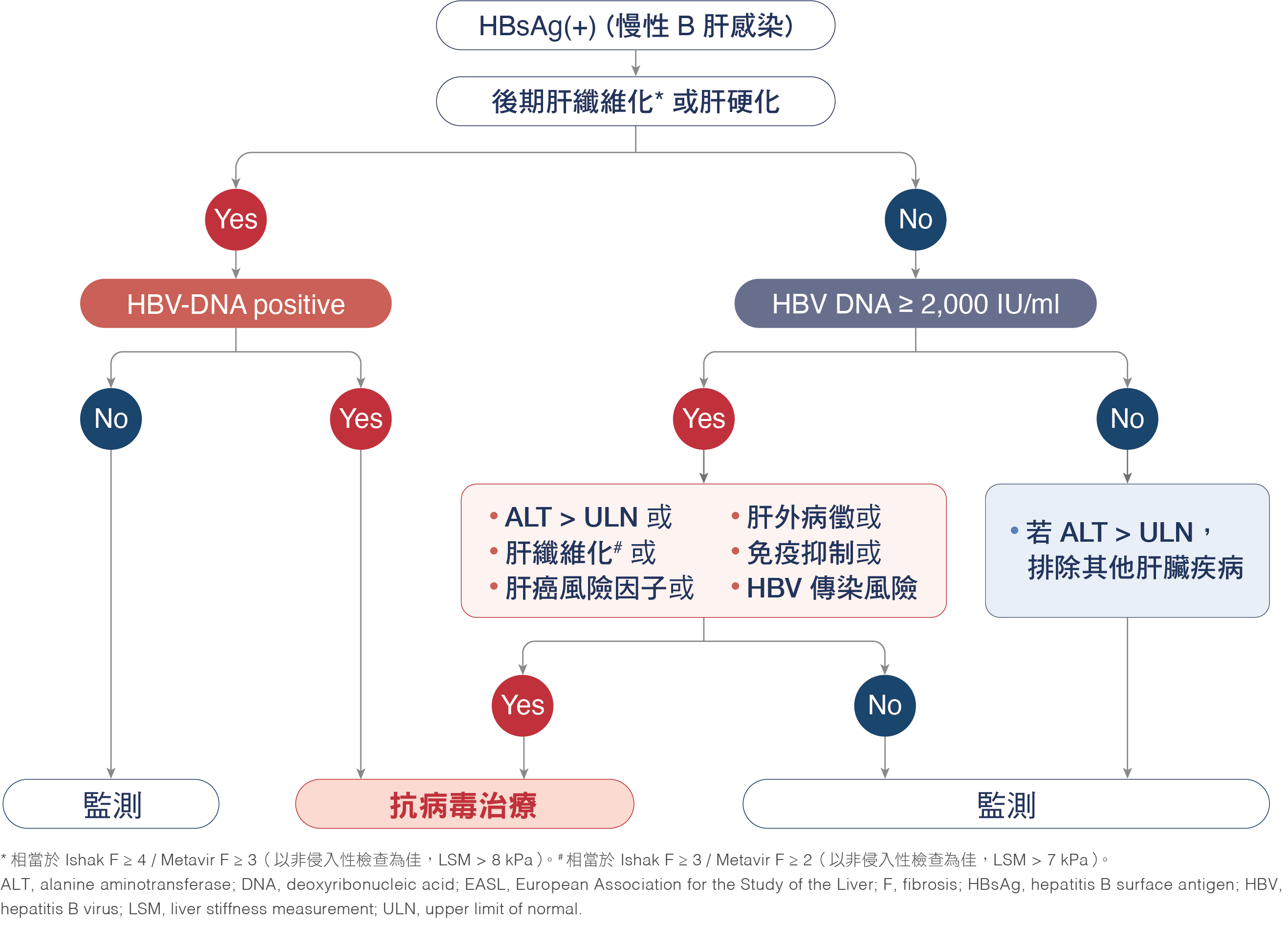
 簡化治療策略:EASL 建議所有 HBsAg(+) 且可測得 HBV DNA
的病人,均適合接受抗病毒治療。起始治療的考量因素主要包括 HBV DNA 和
ALT、肝纖維化分期,以及肝病進展和肝癌風險(強共識) 。建議採取簡化的治療策略(圖一),避免根據 HBeAg
狀態或疾病分期來對病人進行分類。
簡化治療策略:EASL 建議所有 HBsAg(+) 且可測得 HBV DNA
的病人,均適合接受抗病毒治療。起始治療的考量因素主要包括 HBV DNA 和
ALT、肝纖維化分期,以及肝病進展和肝癌風險(強共識) 。建議採取簡化的治療策略(圖一),避免根據 HBeAg
狀態或疾病分期來對病人進行分類。